Swimming holes and exploration

Summer is here, and with temperatures reaching 40 degrees Centigrade (that’s 104 Fahrenheit for our American cousins) some days, we wanted to explore the Blue Mountains National Park. With shade from its trees and the prospect of taking our son paddling in the swimming holes, we headed out for Jellybean pool on a Saturday morning.

To our joy, no-one else was there, and we had a couple of hours to ourselves, exploring and splashing around, and I had some time to try out the Fujinon XF60mmF2.4 Macro on my new X-E1. While most people seem to go for the XF35, the XF60 is a fantastic lens to have in my camera bag. The focal length meant I could stay far enough away from my son while he played that I didn’t distract him (although the photo of him digging in the sand ended up in a major engineering project for us – I think he was trying to tunnel back to the UK). At wide apertures, the XF60 is able to separate the subject and background really nicely, and has almost Zeiss-like micro-contrast. It’s also extremely sharp. I can see this doubling up as a nice portrait lens. As a macro lens, it performs very well, although it only does 1:2 magnification, rather than the 1:1 of most macro lenses. I was able to hand-hold these shots (and remember, there is no image stabilisation) perfectly well. So, this lens inevitably makes compromises to achieve all these things at the size and weight Fuji have managed to get this down to, but for the extra usability (and the ease with which I can carry it around), it trumps my Canon 100mm macro lens, hands down.

Something else I learned – calling something Jellybean pool can lead to confectionary-related disappointment for a 4 year-old!

Jellybean pool - Fujifilm X-E1 + XF60mmF2.4 Macro

Jellybean pool – Fujifilm X-E1 + XF60mmF2.4 Macro

Jellybean pool - Fujifilm X-E1 + XF60mmF2.4 Macro

Jellybean pool – Fujifilm X-E1 + XF60mmF2.4 Macro

Reflections at Jellybean pool - Fujifilm X-E1 + XF60mmF2.4 Macro

Reflections at Jellybean pool – Fujifilm X-E1 + XF60mmF2.4 Macro

Campfire remains at Jellybean pool - Fujifilm X-E1 + XF60mmF2.4 Macro

Campfire remains at Jellybean pool – Fujifilm X-E1 + XF60mmF2.4 Macro

Lichen at Jellybean pool - Fujifilm X-E1 + XF60mmF2.4 Macro

Lichen at Jellybean pool – Fujifilm X-E1 + XF60mmF2.4 Macro

Digging in the sand at Jellybean pool - Fujifilm X-E1 + XF60mmF2.4 Macro

Digging in the sand at Jellybean pool – Fujifilm X-E1 + XF60mmF2.4 Macro

Exploring at Jellybean pool -  - Fujifilm X-E1 + XF60mmF2.4 Macro

Exploring at Jellybean pool – – Fujifilm X-E1 + XF60mmF2.4 Macro

Red shoes at Jellybean pool - Fujifilm X-E1 + XF60mmF2.4 Macro

Red shoes at Jellybean pool – Fujifilm X-E1 + XF60mmF2.4 Macro
Sydney Street #2 – What is Street Photography?

If there’s one form of photography guaranteed to stir up strong opinions, it’s street photography. Why? Let’s start by understanding what is considered to be street photography.

Wikipedia describes it as

a type of documentary photography that features subjects in candid situations within public places such as streets, parks, beaches, malls, political conventions and other settings.

Street photography uses the techniques of straight photography in that it shows a pure vision of something, like holding up a mirror to society. Street photography often tends to be ironic and can be distanced from its subject matter, and often concentrates on a single human moment, caught at a decisive or poignant moment. On the other hand, much street photography takes the opposite approach and provides a very literal and extremely personal rendering of the subject matter, giving the audience a more visceral experience of walks of life they might only be passingly familiar with. In the 20th century, street photographers have provided an exemplary and detailed record of street culture in Europe and North America, and elsewhere to a somewhat lesser extent.

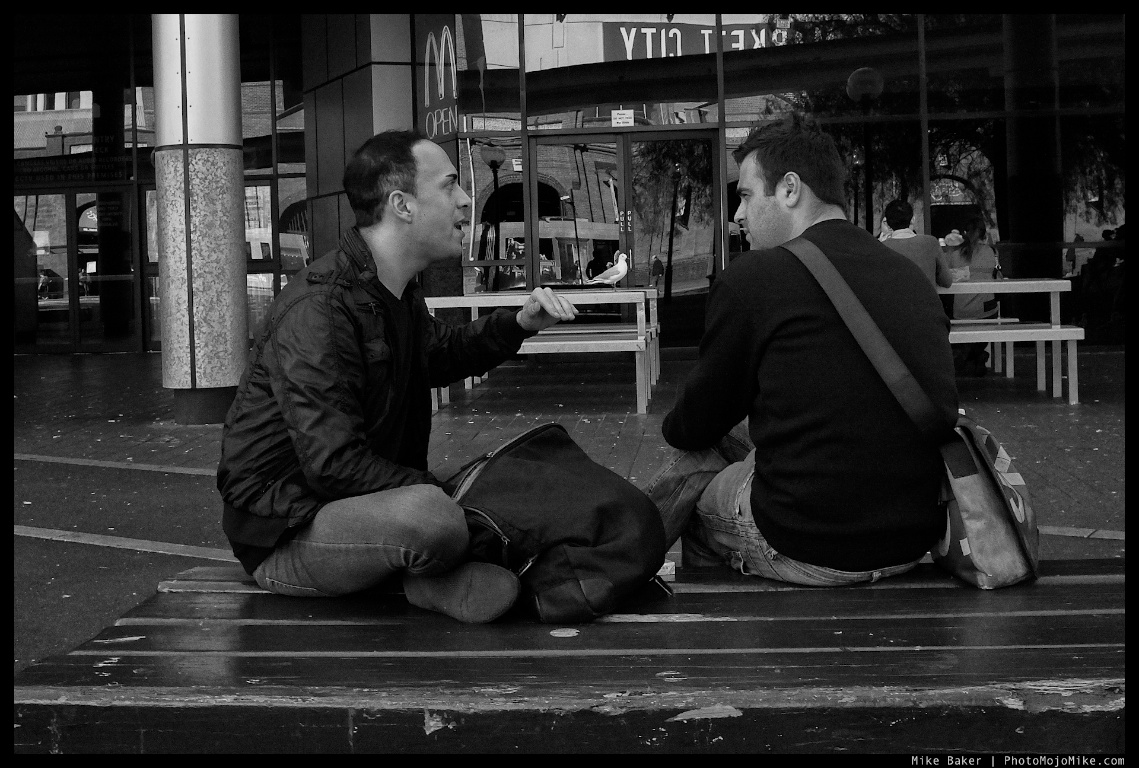
Deep In Conversation

So what does this mean for me? Above all, I see my street photographs as documentary in nature. I am an observer, capturing individual moments which show context and I aim to tell a story – the interaction between people and their environment and each other.

There is a “style” of street photography that attempts to interact with people on the street by shocking them (such as leaping out in front of them and firing a flash) and provoking a reaction that would not exist without the photographer. This doesn’t appeal to me one iota. Not only do I think it shows a lack of respect to others (how would you feel if someone did this to you?), but the photographer changes from an observer to a participant, essentially rearranging the scene to suit them.

Similarly, asking people if you can photograph them before-hand alters the whole dynamic of the scene. Once people become conscious that they are being photographed, their behaviour changes, and you are no longer capturing a “true” or “real” situation.

Rich Pickings

So I observe, and capture those moments of interaction.

Audience

Sydney Street #1

I have joined a street photography group on Meetup, as I’ve always been interested in capturing moments of life, and now that I live in (well, nearby now) Sydney, I found myself inspired when walking the streets. It’s such a vibrant city, with lives that flow and intertwine in front of my eyes every time I step out onto the pavement.

The organiser (Nathan) did a great job. With 38 people turning up, we split into groups with a more experienced lead, and headed out for a couple of hours of “shutter therapy“.

Real Kodak Pictures

A lot of bottle

Textual focus

P.S. I am experimenting with WordPress HiDPI support, so if anyone with a wondrous Apple MacBook Pro Retina display is reading this, I hope you are getting the full, high resolution versions!